
Luxury Living Room Interior Design Ideas for Grand Villas
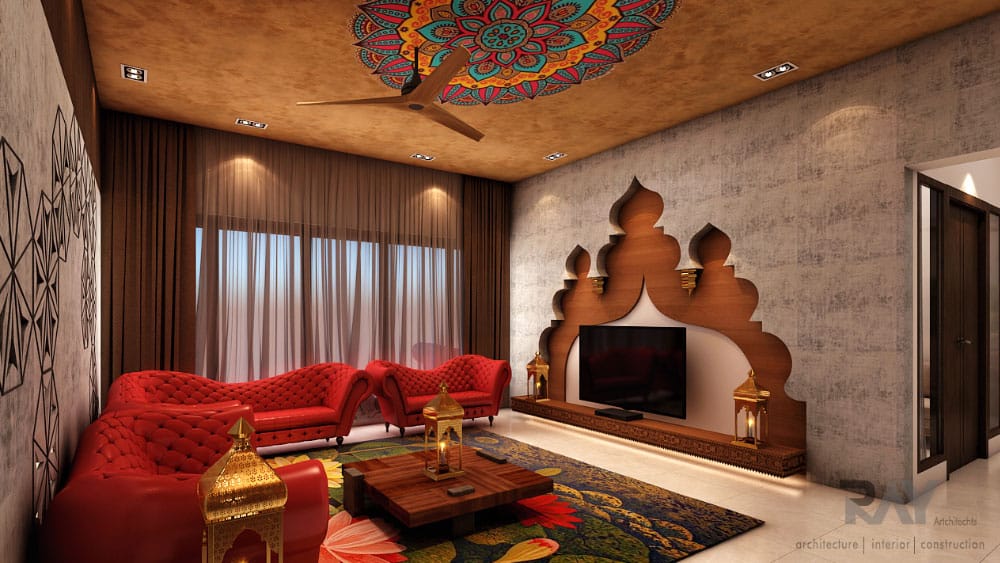
There is a moment that happens in every well-designed villa. You cross the threshold, and something shifts. The air feels different. The space opens in a way that makes you pause, not because you are deciding where to go, but because the room asks you to simply be present. That moment, often attributed to scale or style, is almost always the result of luxury living room interior design executed with uncommon intention.
In a grand villa, the living room is not a room at all. It is a declaration. It establishes the emotional register of the entire home, the quality of light that will follow you through its corridors, the degree of openness or enclosure that will define how the family inhabits the space across seasons and years. It is where guests first form their understanding of who lives here, and where the family itself returns, again and again, as the gravitational centre of daily life.
To design it well is to understand that luxury is not a surface quality. It is spatial. It is felt before it is seen.
The Role of the Living Room in Luxury Villa Design
In residences of this calibre, every room carries weight. But the living room carries a particular kind of weight: the weight of identity. It is the space that most completely reflects the values of the people who commissioned the home, their relationship to openness, to material, to gathering and to solitude.
A grand living room design does not announce itself through excess. It announces itself through restraint applied with confidence. Through the choice of a single stone that is allowed to speak without competition. Through a ceiling proportion that makes you aware of your own presence in the volume. Through the placement of a single work of art that a visitor will stand before, without knowing quite why they stopped.
The living room sets the tone for the entire home in the same way that a first sentence sets the tone for a piece of writing. Every spatial decision that follows, the width of a corridor, the intimacy of a study, the warmth of a dining room, is understood in relation to it. This is why luxury living room interior design must be considered not as an isolated brief, but as the opening movement of a longer, larger composition.
Designing for Scale: The Power of Double Height Living Rooms
Volume is one of the most underused instruments in residential design. In double height living room interiors, the vertical dimension becomes a spatial event in itself. The ceiling rises not merely to allow more air, but to change the quality of experience entirely. You feel the room differently when you can see where the light comes from, when your eye travels upward and finds, not a flat plane, but a considered detail, a sculpted recess, an expressed beam, a wash of light falling from a source you cannot immediately locate.
There is an emotional impact to height that operates below conscious thought. Tall spaces induce a kind of openness in the body. Breath deepens. Tension releases. In a home where the demands of contemporary life are considerable, a double height living room interior offers something that square footage alone cannot: the feeling of genuine expansiveness.
This vertical generosity also creates opportunity. A mezzanine level that overlooks the living space below, creating connection without intrusion. A double-height wall that can carry a large-scale artwork with the authority it deserves. Clerestory glazing that draws afternoon light deep into the plan, reaching corners that a conventional ceiling would never illuminate. Double height living room interiors are not an architectural gesture for its own sake. They are a commitment to a certain quality of lived experience.
Key Elements of Luxury Living Room Interior Design
Statement Ceilings and Architectural Detailing
The ceiling is the most neglected surface in residential design, and in luxury living room interior design, it is among the most powerful. A ceiling that has been considered, whether through the integration of expressed structure, the depth of a coffered grid, the warmth of a timber cladding, or the subtle drama of a recessed light trough, changes the character of a room completely. It gives the eye somewhere to travel and the room a sense of being finished from all six sides, not just four walls and a floor.
Architectural detailing at this level is never decorative for its own sake. The reveal between a stone wall panel and a plastered ceiling, the shadow line above a built-in bookcase, the expressed junction of two different materials at a threshold: these details are the fingerprints of a room that was designed from the inside out.
Material Palette and Texture Layering
In a high ceiling living room design, the material palette must work across great distances. A stone that reads beautifully at arm's length must also hold its presence from across a twelve-metre living volume. This is why the selection of materials in a grand living room is never simply an aesthetic decision. It is a spatial one.
Texture layering is the discipline of allowing surfaces to speak to one another across a room without competing. A rough-cut limestone wall in conversation with a smooth plaster ceiling. A woven textile on a sofa that echoes the grain of a timber floor. Brushed bronze hardware that finds its counterpart in the warm vein of a marble surface. The goal is not visual complexity. It is sensory depth.
Lighting as a Design Feature
Lighting in a modern luxury living room is not a utility. It is an architectural material. The quality and direction of artificial light should be designed with the same rigour as the placement of a window or the selection of a stone. This means understanding how the room will be used at different times and creating a lighting composition that responds to each scenario: the full brightness of a daytime gathering, the warm pool of a reading lamp in the late evening, the dramatic wash of an art wall in candlelight.
In double height volumes, lighting design takes on additional complexity and additional opportunity. Uplights that graze a textured wall and reveal its depth. Pendants that hang at a scale proportionate to the height, anchoring the room without overwhelming it. Concealed light sources that trace the geometry of a ceiling detail and turn structure into luminous line.
Custom Furniture and Bespoke Pieces
Furniture in a villa of this scale must be bespoke in the truest sense. Not simply customised in fabric or finish, but conceived from the beginning in response to the specific proportions, the specific light, and the specific life of the room it will inhabit. A sofa whose depth is determined by how a particular family prefers to sit. A coffee table whose height is calibrated to both the seating and the artwork it will face. A console piece that reads as an extension of the wall rather than something placed in front of it.
Bespoke furniture in luxury villa interiors India is increasingly understood as architecture in a smaller register. It defines zones, anchors spatial experiences, and contributes to the material narrative of the room with the same authority as a stone wall or a structural column.
Art, Sculptures, and Focal Points
A grand living room without a focal point is a room without intention. Art and sculpture in a space of this scale are not accessories. They are spatial anchors. The placement of a large-format canvas on a double-height wall, or a sculptural piece at the threshold between living and circulation, transforms the room from a well-designed space into an experiential one. These objects give the eye a destination and the room a reason to be traversed.
Premium Villa Living Room Ideas That Define Elegance
There is no single expression of a grand living room. The premium villa living room ideas that resonate most deeply are those that emerge from a specific set of values, a particular way of inhabiting light and silence and social life, rather than from a catalogue of aesthetic references.
Minimal luxury draws its power from radical reduction. A single material, allowed to occupy an entire wall. Furniture whose forms are so considered that they require no embellishment. Light that arrives from a concealed source and seems to have no origin. The restraint is absolute, and within that restraint, every detail becomes weighted with meaning.
The modern classic living room works through the dialogue between permanence and refinement. Marble floors of a classical scale paired with furniture of clean, contemporary proportion. Moulded plaster ceilings reinterpreted in a language that feels neither historicist nor purely modern. Materials that carry depth of time, aged bronze, hand-planed timber, hand-laid stone, presented with the precision of a contemporary eye.
Contemporary Indian luxury is perhaps the most nuanced of these expressions, and the most exciting. It draws on the material traditions of the subcontinent, the warmth of handwoven textiles, the depth of hand-carved stone, the sensory intelligence of a climate-responsive spatial layout, and recasts them within a rigorous contemporary architectural language. The result is a luxury villa interior that could only exist here, that carries the particular intelligence of place without resorting to the familiar language of pastiche.
Glass-heavy indoor-outdoor living rooms dissolve the boundary between the interior and the landscape beyond. Full-height glazed walls that fold away entirely. Flooring that continues without interruption from the interior to the terrace. The living room becomes, in certain moments of the day and year, continuous with the garden, the sky, the distant horizon. This is among the most powerful of the premium villa living room ideas because it achieves grandeur without volume alone: it borrows the scale of the outdoors.
Seamless Integration with Architecture
The finest luxury interior design cannot be separated from the architecture that surrounds it. When these two disciplines are unified from the beginning of the design process, the living room gains a quality that no amount of subsequent decoration can supply: inevitability. The sense that the room could not have been otherwise.
This means that the height of the ceiling, the placement and proportion of windows, the relationship between the living volume and the spaces that adjoin it, and the movement of light through the day are all considered together with the interior material palette, the furniture layout, and the art placement. The structural column that appears in the plan becomes the element around which a seating zone is organised. The window that faces west becomes the reason a particular stone was chosen for the wall it illuminates at dusk. The threshold between inside and outside is not a glazing detail but a spatial experience designed from both sides simultaneously.
In luxury villa interiors India, where climate, orientation, and the rhythm of family life place particular demands on how a living space must perform, this integration is not a luxury of process. It is a necessity of outcome.
"The living room that endures is one where the architecture and the interior have been in conversation since the first line was drawn. Nothing negotiated. Everything resolved."
The Experience of a Well-Designed Living Room
What a well-designed living room produces is not easily photographed. It is the quality of the first few seconds after you enter: a particular stillness, a sense that the room is composed without being stiff, generous without being overwhelming. The light is doing something you cannot immediately explain. The proportions feel right in a way that you would struggle to articulate.
Movement through the room flows without instruction. You know, instinctively, where to sit, where to stand, where to pause. The room has a grain to it, a directionality, that guides without imposing. In a high ceiling living room design, this feeling is amplified by the vertical dimension. The volume above you is present without pressing down. It creates a kind of spatial breathing room that persists even when the room is full of people and conversation.Understated grandeur is the quality that distinguishes the best luxury living rooms from the merely impressive. It is the difference between a room that asks to be admired and one that asks to be inhabited. The room does not perform. It holds.
Common Design Mistakes in Large Living Rooms
The scale of a grand living room creates as many opportunities for error as it does for excellence. Overcrowding is perhaps the most common: the instinct to fill a large volume with furniture, objects, and surfaces in proportion to its size, resulting in a room that feels neither grand nor intimate, simply busy. Scale is not solved by adding more. It is solved by understanding which elements are structurally important to the spatial experience and allowing those elements the room to be fully present.
Poor scale matching creates a different problem. Furniture that is well-proportioned for a standard residential room appears to shrink within a double-height living volume. Pendants that would anchor a three-metre ceiling hang apologetically in a five-metre space. Every element must be selected, and in some cases custom-made, with full awareness of the spatial context it will inhabit.
Ignoring vertical space is a consistent omission in high ceiling living room design. The upper half of a double-height room is as much a part of the spatial experience as the floor plane. When it is left undifferentiated, the grandeur of the volume becomes a liability rather than an asset: a large, unresolved emptiness above a well-furnished lower half. Vertical space must be activated through considered detailing, lighting, art, or the integration of a mezzanine that overlooks without intruding.
Disconnected lighting is perhaps the most technically complex mistake to avoid. In a room of this scale, a single lighting type or a single lighting layer is never sufficient. When ceiling lights illuminate a floor but leave walls in shadow, when pendant fixtures are placed without regard to seating geometry, when natural and artificial light have not been considered as a unified system, the room loses coherence after dark. And a living room in a villa of this kind is used in many different qualities of light across a day. All of them must be designed.
The RAY Artchitects Approach
At RAY, the living room is never approached as a room to be furnished. It is approached as a spatial experience to be authored. The proportions, the material relationships, the quality of natural light, and the movement of people through the volume are all established at the architectural stage, with full knowledge of how the interiors will develop. Nothing is handed off. Nothing is resolved at the remedial stage.
This means that when a living room emerges from the RAY process, it carries a quality of intention that extends from the thickness of the stone cladding to the height of a custom sofa back. The bespoke pieces are not bespoke for the sake of distinction. They are bespoke because the room requires them to be exactly as they are: no variation in dimension would serve the space as well.
The attention to proportion that defines this approach is not a stylistic preference. It is an understanding that in a space of this scale and permanence, proportion is the primary material. Get it right, and everything placed within it has the conditions to be truly itself.
Conclusion
Luxury, in the living rooms of the finest villas, is never excess. It is the particular quality that emerges when scale, material, light, and proportion are resolved with sustained intelligence. When a family enters a space that was designed to hold their specific way of living, the effect is not showmanship. It is recognition.
Luxury living room interior design at its deepest level is the discipline of creating rooms that do not need to announce themselves. That are simply, completely, and quietly what they were always meant to be. Rooms where the architecture and the interiors are one language, spoken without interruption from the first stone laid to the last surface placed.
For the families who commission homes of this nature, the living room is not the most impressive room in the house. It is the most true.
If you are ready to design a living room that feels as considered as it looks, let us begin.
FAQs
What does architecture and interior design integration mean in a luxury home?
It means both disciplines are conceived together from the start, not coordinated after the fact. Every structural, material, and spatial decision shares a single design intention, resulting in a home that feels coherent rather than assembled.
Why does fragmented design feel unsatisfying even in expensive homes?
Because the body registers discord before the mind can name it. Mismatched proportions, conflicting material tones, and furniture scaled for a different volume all create a quiet unease. The home feels complete but never quite settled.
How does material continuity shape the experience of a villa?
When materials are selected as part of a unified palette spanning architecture and interiors, the home feels authored rather than decorated. Transitions between surfaces become as intentional as the surfaces themselves, creating a spatial narrative that flows naturally from room to room.
How does luxury home planning in India differ from global counterparts?
Indian luxury homes carry distinct demands: climate-responsive design, multi-generational living, and a desire for spaces rooted in local material culture. These layers make the integrated approach not just desirable but essential for homes that feel genuinely of their place.
What is the difference between villa architectural interiors and standard interior design?
In villa architectural interiors, the interior life of a home actively shapes the architecture, not the other way around. Room proportions, openings, and spatial transitions are all informed by how the family lives, from the very first design decision.